
If that scenario sounds familiar — or like something you've narrowly avoided — you're not alone. Blown fuses are one of the most common, most overlooked causes of small electrical failures in family vehicles. The good news: they're also one of the cheapest and easiest things to fix yourself, if you're carrying the right parts.
That's the whole idea behind keeping a car fuses assortment kit in your glovebox. It's not expensive, it doesn't take up much space, and it can turn a stressful roadside moment into a two-minute fix. Let's talk about what fuses actually do, why they fail, and which kit is worth keeping in the car.
What Are Car Fuses, and Why Do They Blow?
Think of a fuse as a tiny, sacrificial safety switch. Every electrical circuit in your car — headlights, power windows, the radio, your phone charger, the rear defroster — runs through a fuse. If something pulls more electrical current than that circuit is designed to handle, the fuse is built to "blow" (break the connection) before the wiring or the component itself gets damaged.
In plain terms, a fuse blowing is usually a good thing. It's doing its job and protecting something more expensive from getting fried. Common reasons fuses blow include:
Overload – too many accessories drawing power on one circuit (think phone chargers, dash cams, and seat heaters all running at once)
Short circuits – a worn wire or corroded connector accidentally completing a circuit it shouldn't
Old age – fuses can simply wear out over years of vibration and temperature swings
A failing component – sometimes the part itself (a motor, a pump) starts pulling too much current as it dies
Modern family vehicles have far more of these circuits than cars from even ten years ago. Backup cameras, heated seats, power liftgates, USB hubs, lane-assist sensors — it all adds up. More electronics means more fuses, and more fuses means a slightly higher chance that one of them will need replacing at some point. This is part of why a basic understanding of blade fuses automotive systems is genuinely useful for any parent who drives regularly.
Why You Should Carry a Fuse Kit — Not Just One Fuse
Here's the part that catches a lot of people off guard: fuses aren't one-size-fits-all. Even within the same vehicle, different circuits use different fuse sizes. The three most common blade fuse formats are:
Standard (ATO/ATC) – the original, slightly larger blade fuse
Mini – a smaller version used heavily in newer vehicles
Low-Profile Mini – the smallest and slimmest, often used where space is tight
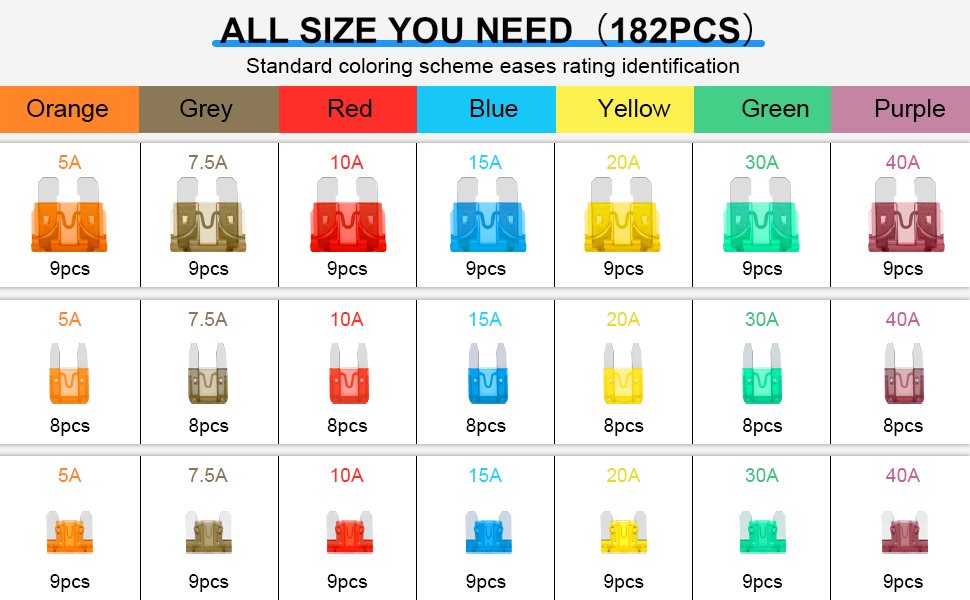
On top of the size, each fuse also has an amperage rating (5A, 10A, 15A, 20A, and so on), and using the wrong amp rating can cause more problems than it solves. This is exactly why a single spare fuse from the hardware store rarely helps in a real situation — odds are it's the wrong size, the wrong amp rating, or both. A proper standard mini low profile fuse kit covers all three formats and a wide range of amperages, so whatever blows, you've actually got a matching replacement on hand.
What to Look for in a Good Fuse Kit
Not all fuse kits are created equal. When you're shopping for a best fuse kit for car use, a few things separate the genuinely useful ones from the kits that just look impressive in a photo:
Quality terminal material – zinc alloy terminals resist corrosion and conduct more reliably than cheap stamped metal
Clear color-coding and amp labeling – so you're not squinting at tiny print on the side of the road
An included fuse puller – fuses are small and gripping them with pliers or fingernails is awkward at best
A sturdy, organized storage case – loose fuses rattling around in a sandwich bag in your glovebox is a recipe for losing half of them
Broad size and amperage coverage – so the kit works across more than just one vehicle
This is exactly the gap that a well-built emergency car fuse set like the cooclensportey 182-Piece kit is designed to fill.
Get It on Amazon Before It's Gone →
Product Deep-Dive: cooclensportey 182-Piece Fuse Assortment Kit
The cooclensportey 182-Piece Car Fuses Assortment Kit is built specifically around the problem we just described: covering every common fuse size and amp rating your family vehicle is likely to need, in one compact case.
Feature | Details |
|---|---|
Total pieces | 182 fuses + 1 fuse puller |
Fuse types | Standard, Mini, and Low-Profile Mini blade fuses |
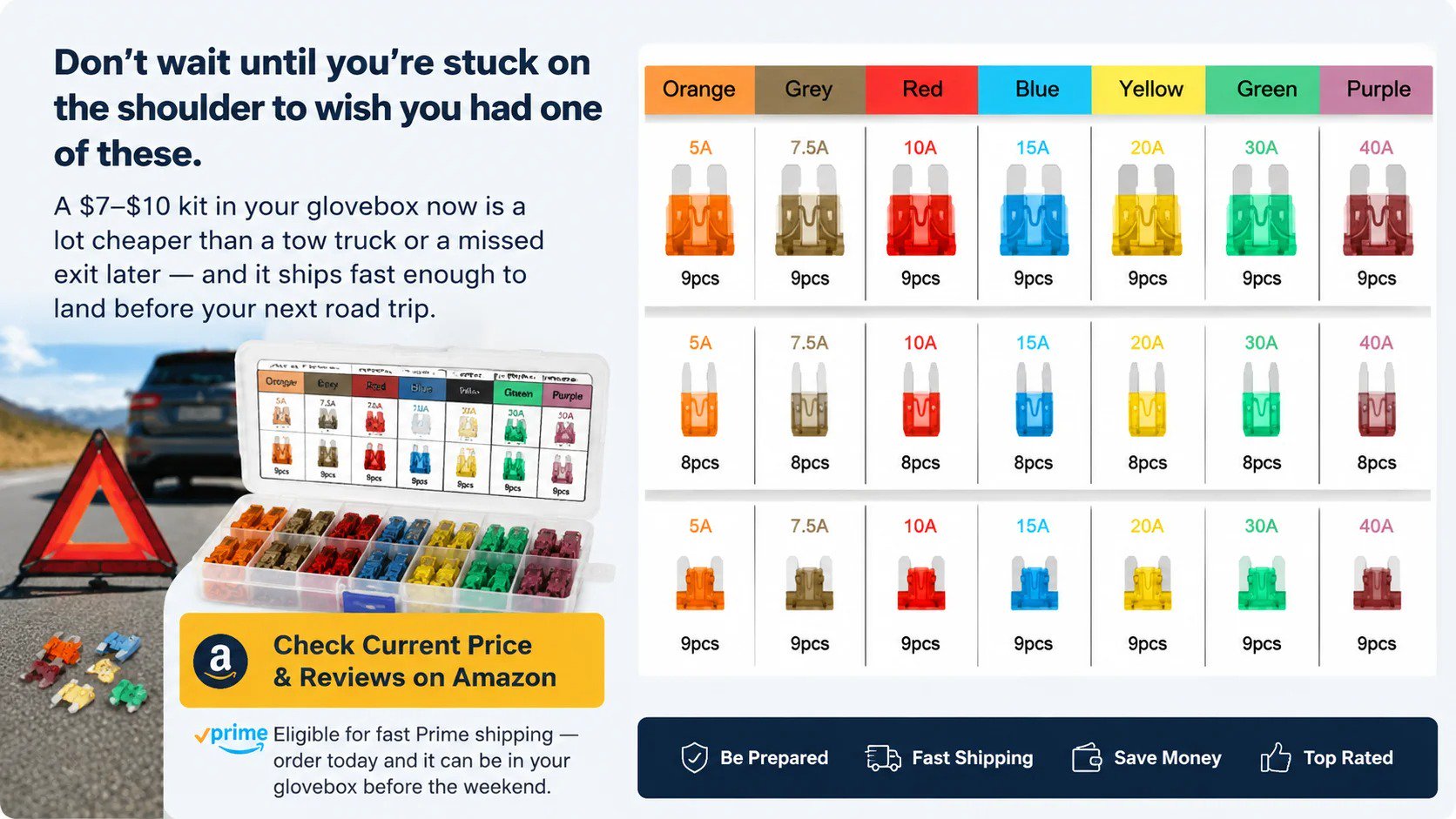
Amp ratings covered | 5A, 7.5A, 10A, 15A, 20A, 30A, and 40A |
Terminal material | Zinc alloy, for corrosion resistance and better conductivity |
Organization | Color-coded by amperage, clearly labeled, durable storage case |
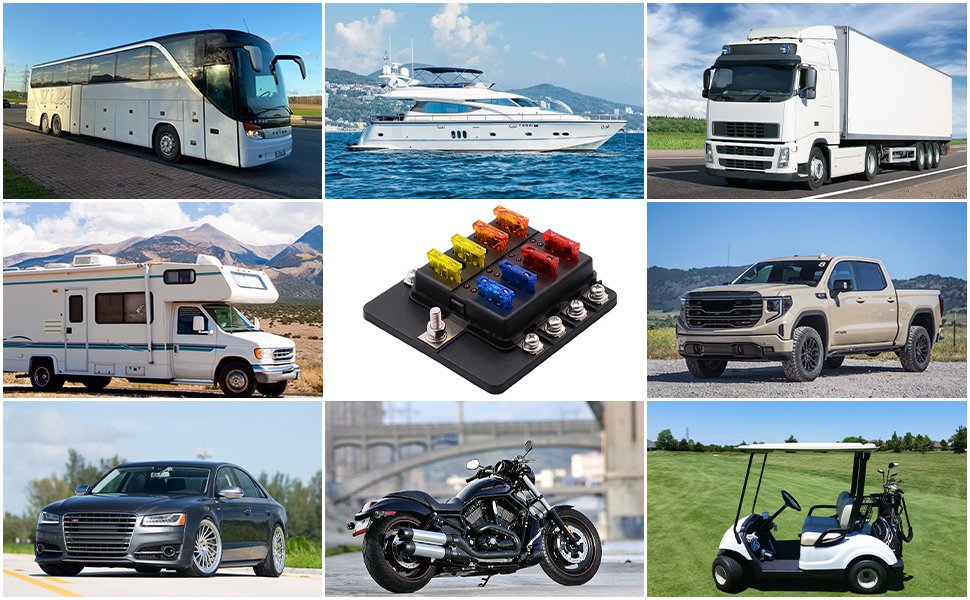
Compatible with | Cars, trucks, SUVs, ATVs, RVs, and boats |
A few details worth pointing out for parents specifically:
It covers all three formats in one box — so you're not guessing whether your minivan uses Mini or Standard fuses, you've simply got both
It comes with a fuse puller, which sounds minor until you're trying to pry a tiny fuse out of a tightly packed fuse box with cold fingers in a parking lot
The case keeps everything organized, so the kit stays usable two years from now instead of becoming a junk-drawer mess of loose plastic clips
You can see the current price, full size breakdown, and customer reviews directly on the product page: cooclensportey 182-Piece Fuse Assortment Kit on Amazon.
Real-World Family Scenarios Where This Kit Pays Off
1. The dead 12V outlet on a long drive
You're two hours from home, the kids' tablets are at 5%, and the car's USB or 12V outlet suddenly stops charging anything. In a lot of vehicles, that outlet runs on its own dedicated fuse — separate from your headlights or wipers. A blown 5A or 10A fuse is a very common culprit, and swapping it takes less time than finding a rest stop.
2. The rear wiper that quits mid-storm
Rain is coming down, you're trying to back out of a parking spot, and the rear wiper just stops moving. Wiper motors can draw a fair amount of current, and a blown fuse is one of the first things worth checking before assuming the motor itself has failed.
3. Trailer lights that won't light up before a camping trip
You hook up the trailer the night before a camping trip, do your usual lights check, and the brake lights on the trailer aren't working. Trailer wiring harnesses often run through their own fuse, separate from your truck's main lighting circuit — exactly the kind of thing a quick fuse swap can solve in the driveway instead of on the side of the highway the next morning.
None of these situations require any real mechanical knowledge. They just require having the right size fuse on hand — which is the entire point of carrying a fuse kit for SUV and truck use, or really any family vehicle.
How to Use a Fuse Kit (Step by Step)
Learning how to check a car fuse and replace it is genuinely simple, even if you've never popped your hood for anything beyond windshield washer fluid:
Find your fuse box. Most cars have one under the dashboard near the driver's side, and often a second one under the hood. Check your owner's manual for the exact location and fuse map.
Identify the blown fuse. Pull the fuse for the affected component (the fuse map will tell you which one) and hold it up to the light. A blown fuse will have a broken or burnt-looking metal strip inside.
Remove it with the fuse puller. This little tool grips the fuse without you having to pinch it with your fingers or risk snapping it with pliers.
Insert a replacement of the same amp rating. This part matters — never replace a fuse with a higher amperage one. It's color-coded for a reason; matching colors means matching amps.
Test it. Turn the component back on. If it works, you're done. If the new fuse blows immediately, that usually points to a bigger underlying issue worth having a mechanic look at.
Why Not Just Buy Cheap, Unbranded Fuses?
It's tempting to grab the cheapest fuse multipack you can find, and to be fair, plenty of basic fuses work just fine. But there's a real difference in build quality between bargain-bin fuses with thin, poorly finished metal contacts and ones built with proper zinc alloy terminals.
Lower-quality metal contacts are more prone to corrosion and weaker conductivity, which over time can mean more resistance, more heat, and in worst cases, a fuse that doesn't fully protect the circuit the way it's supposed to. It's a small detail, but it's the kind of small detail that matters more in a part whose entire job is electrical safety. The zinc alloy terminals used in the cooclensportey kit are built with that durability and conductivity in mind.
The Price-Value Math

Even accounting for shipping or future price changes, a fuse kit this comprehensive typically costs less than a single fast-food run for the family — and it can save you an entire mechanic visit's worth of time and money the very first time you use it. After that, every future fuse you don't have to pay someone else to replace is pure savings.
Get It on Amazon Before It's Gone →
Frequently Asked Questions
Will these fuses fit my car?
Almost certainly yes for at least some of your circuits. The kit covers Standard, Mini, and Low-Profile Mini blade fuses — the three formats used across the vast majority of cars, SUVs, minivans, and trucks on the road today. Check your owner's manual or fuse box cover to confirm which format(s) your vehicle uses.
Are the fuses color coded?
Yes. Each amp rating has its own color, and every fuse is also clearly labeled with its amperage, so you can match a blown fuse to its replacement at a glance.
Does it come with a storage box?
Yes, the full set comes organized in a durable, compartmentalized case — small enough for a glovebox or center console, and organized enough that you can actually find the size you need under pressure.
Is a fuse puller included?
Yes. A dedicated fuse puller is included in the case, which makes removing old fuses much easier than trying to use pliers or your fingernails.
What materials are the fuses made of?
The terminals are made from zinc alloy, chosen for corrosion resistance and reliable electrical conductivity compared to cheaper stamped-metal alternatives.
Can it be used in boats or RVs?
Yes. Because the kit covers the common Standard, Mini, and Low-Profile Mini formats, it works across cars, trucks, SUVs, ATVs, RVs, and boats — anywhere these blade fuse types are used.
At the end of the day, a fuse kit is one of those small, inexpensive things that just makes sense to have — right alongside your jumper cables and tire gauge. It won't fix a major mechanical issue, but for the small electrical hiccups that tend to show up at the worst possible time, it can mean the difference between a quick roadside fix and a stressful, expensive detour. If you've been meaning to put one together for your own car, the cooclensportey 182-Piece kit is a solid, well-organized way to check that box.
DailyDriveHouse.com — practical advice for busy families.


Letters
No letters yet — be the first to write.